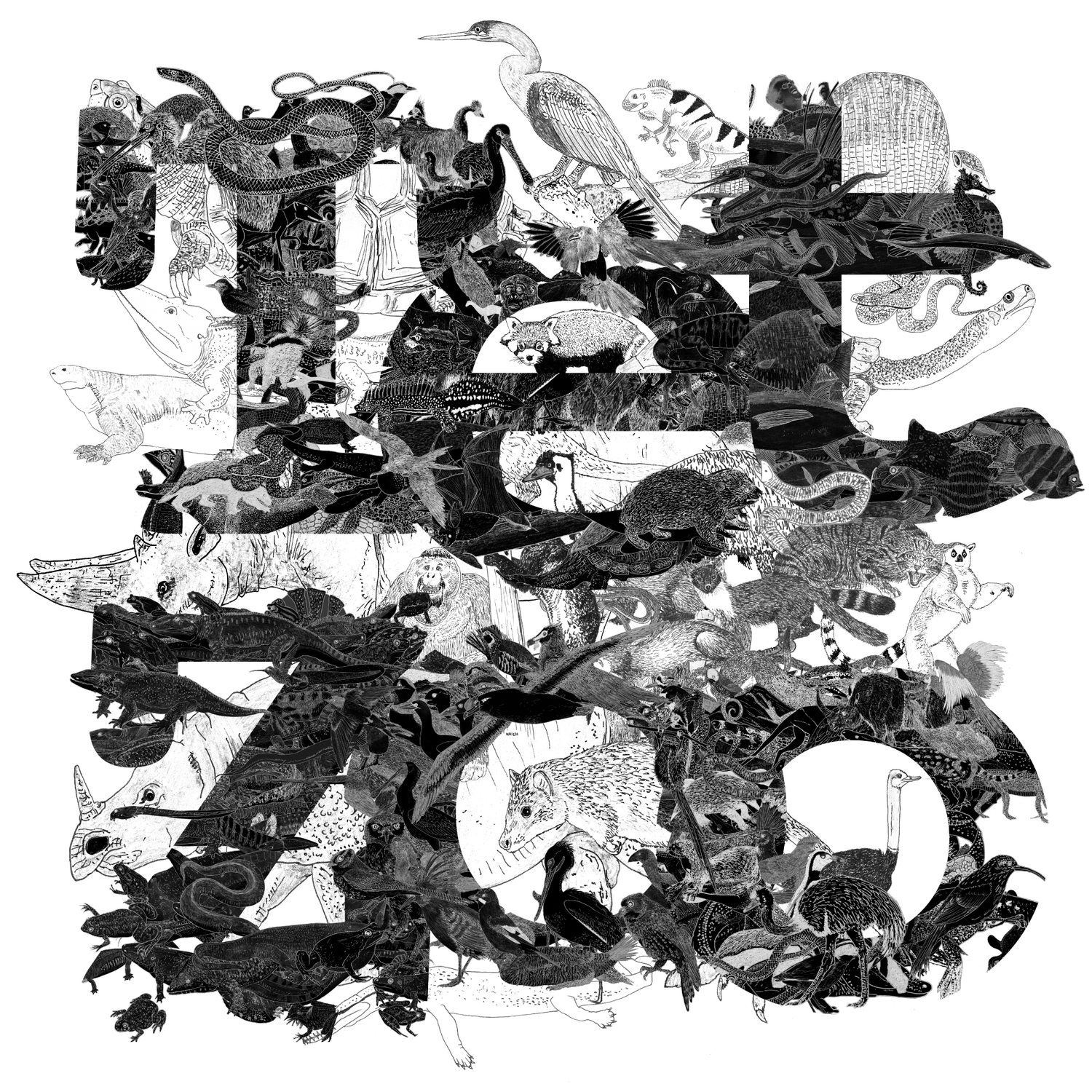
Last year saw the appearance of the long-awaited second edition of Dougal Dixon’s The New Dinosaurs (Dixon 2025). If you’re a fan of the original, published in 1988, now is the time to get a second edition.
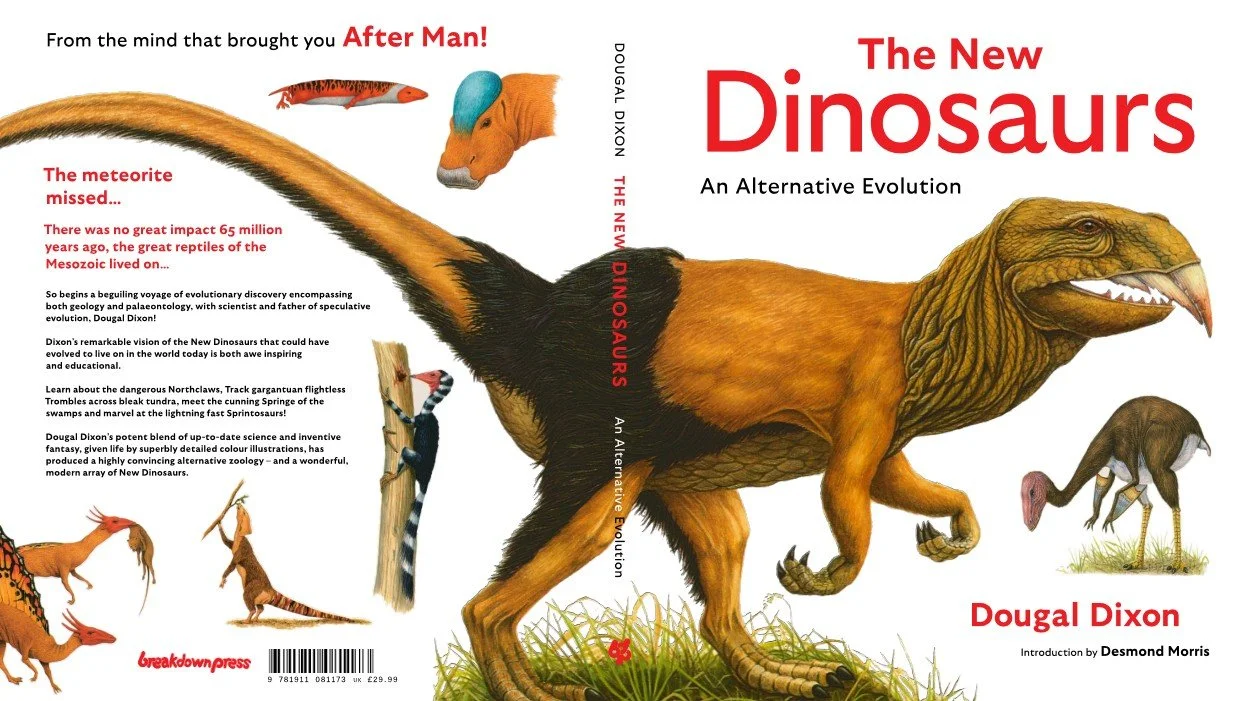
Caption: front and rear covers of the 2025 edition of Dougal Dixon’s The New Dinosaurs: An Alternative Evolution. The large theropod is a Cutlasstooth; to its right is a flightless pterosaur termed the Flarp. The rear cover shows (at top) a Sandle (at left, a fossorial theropod) and the head of a Gwanna, and (at bottom, left to right) a male Dingum (an Australasian coelurosaur), a Bricket (a Palaearctic lambeosaur) and a Nauger (a woodpecker-like arbrosaur).
I attended the London launch event, got hold of a review copy, and have just published a reasonably long article on the book in Historical Biology (Naish 2026). There is, of course, a huge amount of stuff to say about TND, some of which has been touched on here at Tet Zoo before (see the links below). But there are several additional points that haven’t been commented on at all, or – at least – not much, and I used the review as an opportunity to highlight them. I’ll summarise them here, meaning that this article is a summary of a review of a book, how meta. Let me know if you want the full pdf (of the review, not the 2025 edition of The New Dinosaurs. Buy it here).
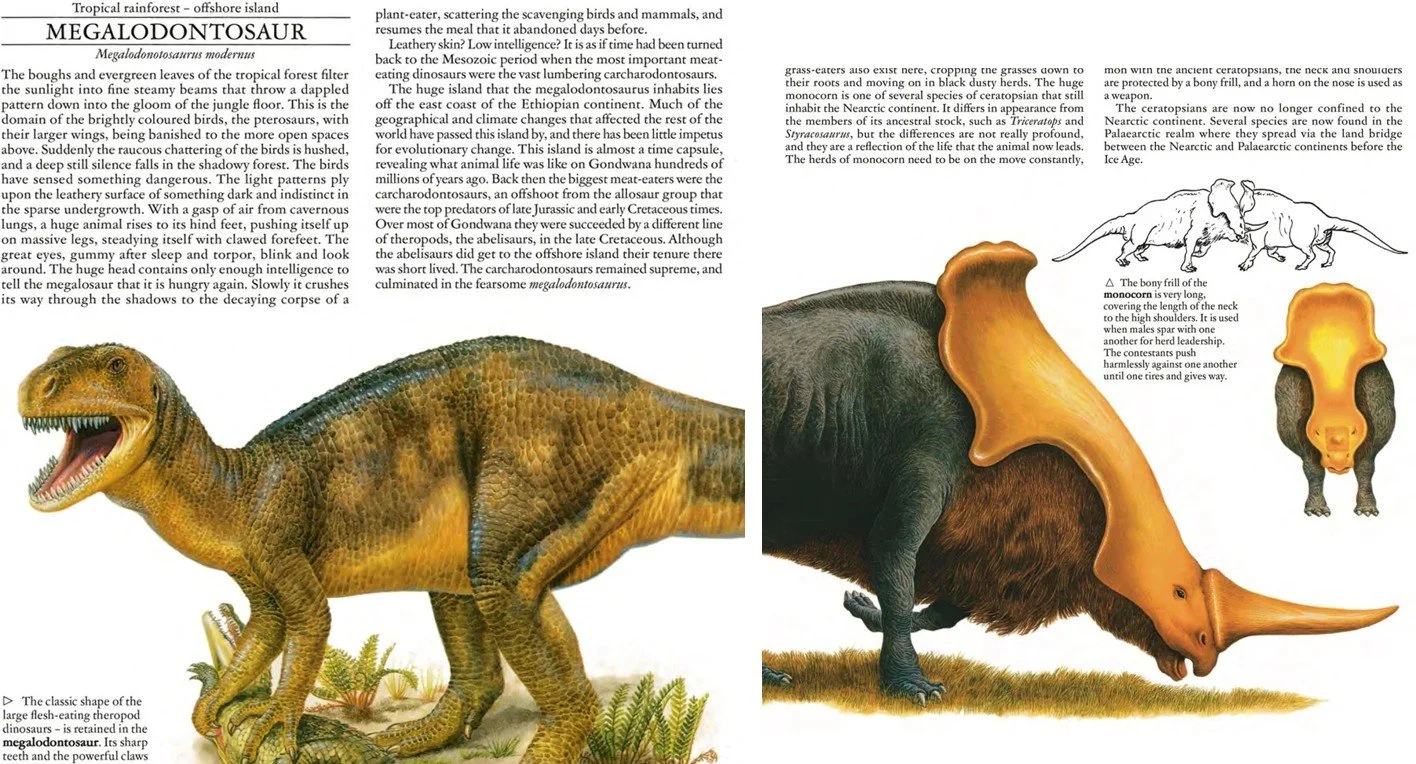
Caption: parts of pages within the 2025 edition of The New Dinosaurs. A Malagasy megalodontosaur at left, a monocorn at right. Yup, that image on the left is by the legendary Denys Ovenden. The ones on the right are by Philip Hood… I own the original!
The New Dinosaurs is part of a 1980s ‘late renaissance’ wave in how Mesozoic archosaurs were depicted and described. Dougal Dixon is one of a list of authors who wrote about Mesozoic dinosaurs (and pterosaurs, and marine reptiles) from a ‘mainstream’, conservative view. There is, in fact, a ‘very British’, staid tradition of writing about these animals that extends from William Swinton in the 1930s to Alan Charig and Beverly Halstead in the 1970s and 80s, and to David Norman, Mike Benton and others during the 80s and beyond.
I mean no disrespect whatsoever here; it’s just the way it is. So when the American authors and artists Robert Bakker, Greg Paul, Mark Hallett and John McLoughlin (plus a few others) began publishing images of fuzzy and feathery ornithischians, thickly furred pterosaurs, bird-like theropods sprinting and leaping high off the ground, and sauropodomorphs rearing, tail-whipping and generally behaving more dynamically than had been the case before (as they did from 1975 onwards)… what to do?
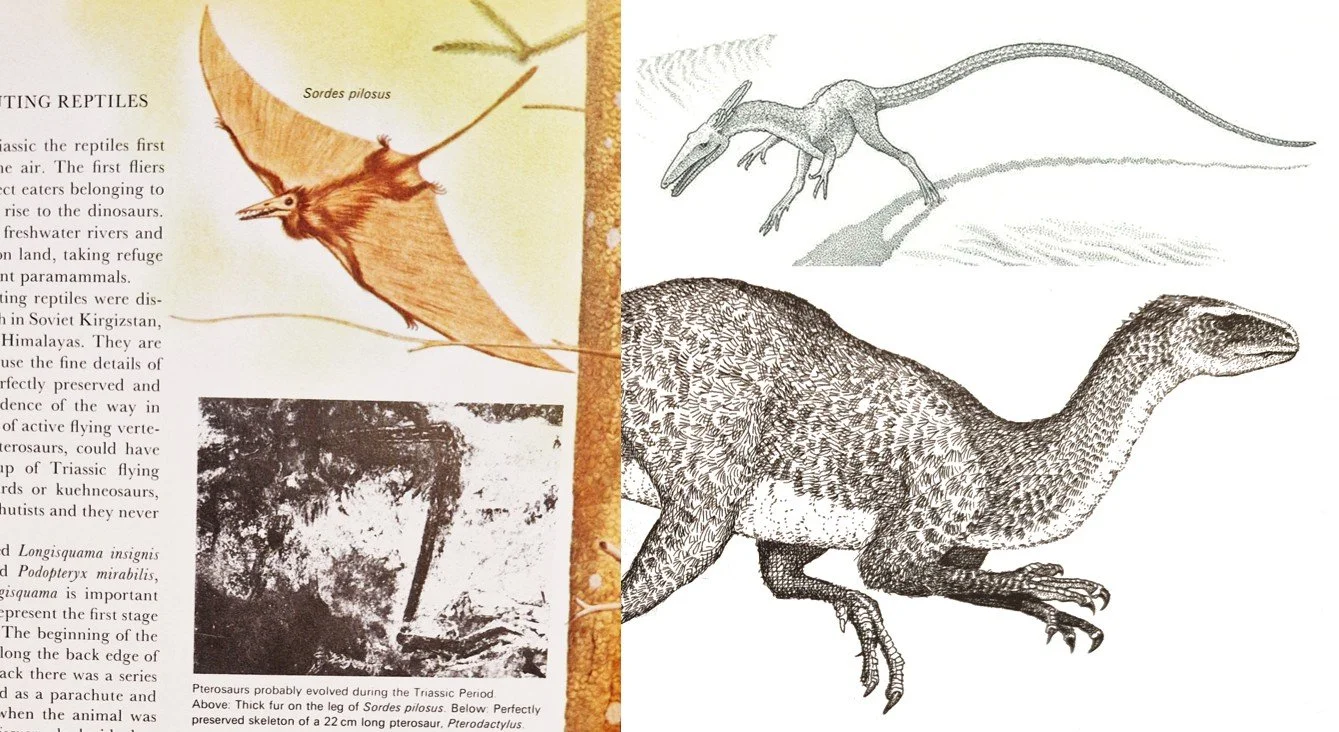
Caption: it’s not true that fuzzy and feathery non-bird dinosaurs were ‘all new’ in the 1990s; they’d been kicking around in the literature for decades prior, as shown by this feathered Syntarsus from Bakker’s 1975 Scientific American article (upper right) and the feathered Coelurus (actually Ornitholestes) from McLoughlin’s 1979 Archosauria book. Fuzziness in pterosaurs was also well known by this time, and even Halstead endorsed this in his book of 1975 (art by Giovanni Caselli).
TND is about fictional animals of an alternative timeline. But a point that’s been missed or ignored until now is that it’s very much of its time, its animals reflecting views new in the 1980s. The pterosaurs are (mostly) capable bipeds whose hindlimbs are free of the wing membranes, a new-fangled idea advocated by Kevin Padian and picked up by artists including Paul and Hallett. The pterosaurs of TND are fuzzy, the theropods are too… but so are the ornithischians, and while there’s support for that view today (from Tianyulong and Kulindadromeus at least), it was elsewhere only being promoted in palaeoart like that by Paul.
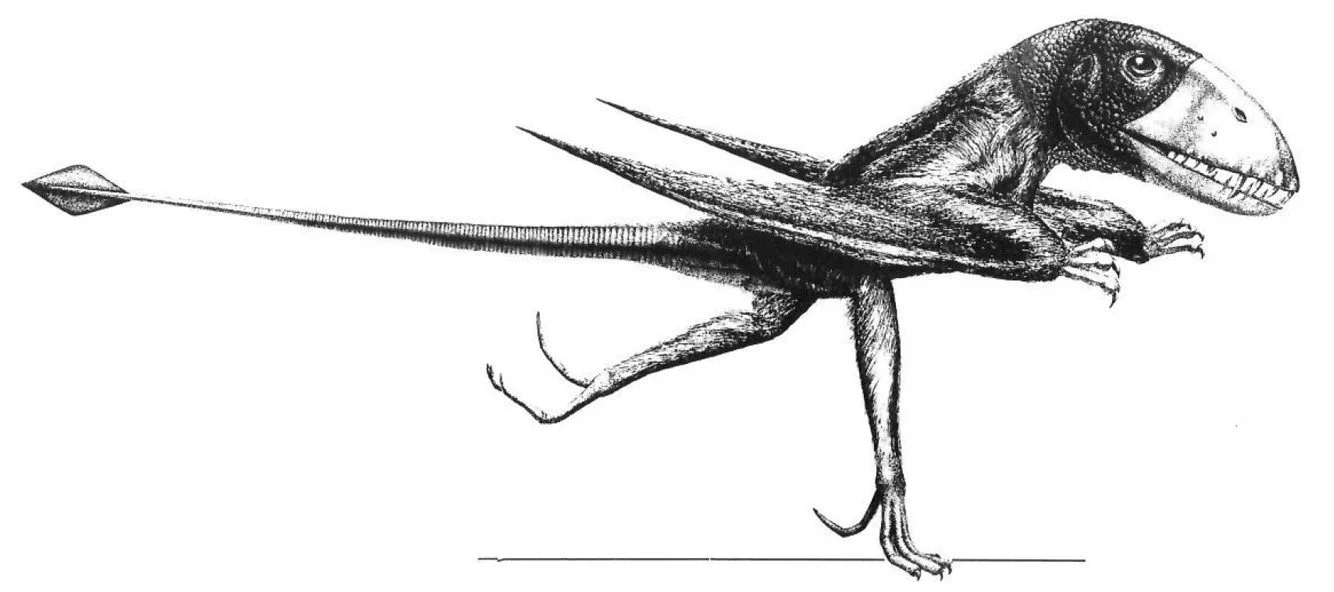
Caption: new ideas on pterosaurs were appearing during the 80s, and one that had its time in the limelight proposed that these animals were agile, cursorial bipeds. This is an iconic image of the Jurassic pterosaur Dimorphodon, by J. Kevin Ramos, and it was used in several of Kevin Padian’s papers and articles published during the 1980s.
I put it that TND marks a departure from the ‘very British’ tradition of portraying these animals and hence should be considered part of this interesting phase of history. The old, conservative interpretation might be on the bonfire; it’s time to adopt a less familiar, stranger, perhaps more exciting view (Naish 2026). Importantly, it’s flat wrong to claim in seriousness than the Dinosaur Renaissance resulted in a negation of all that had gone before; things were far more nuanced (Naish 2021). But it’s also wrong to pretend that nothing happened.
Redemption. I’m hardly the first to point out that various of the animals featured in TND have been part-redeemed by recent discoveries. A giraffe-like, flightless pterosaur is consistent with the ‘terrestrial stalking’ interpretation of azhdarchids (Witton & Naish 2008), dwarf, island-dwelling macronarians are now a real-world thing, the long-faced, fish-eating Dip and superficially pangolin-like Pangaloon of the book are reminiscent of unenlagiines and alvarezsaurids, and ‘whelks’ might well have evolved had aristonectines not gone extinct (Naish 2026).
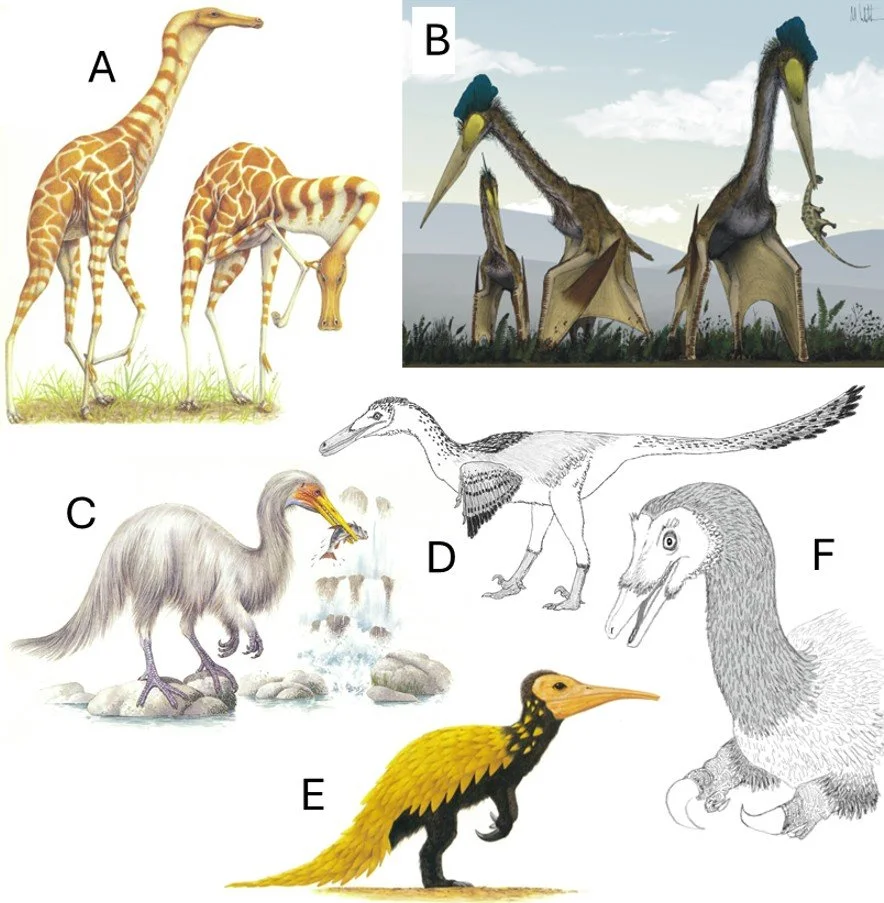
Caption: montage from Naish (2026). Several animals of TND pre-empt palaeontological discoveries and proposals. (A) The Lank of TND (illustration by Steve Holden; from Dixon (2025)) is a large flightless pterosaur that walks with a pacing gait and consumes grasses. (B) Witton & Naish (2008) proposed that azhdarchids were ‘terrestrial stalkers’, inviting comparisons between pterosaurs and giraffes. (C) The Dip of TND (illustration by Denys Ovenden; from Dixon (2025)), a long-faced, piscivorous coelurosaur. (D) Reconstruction of an unenlagiine, a long-faced maniraptoran with piscivorous adaptations. (E) The Pangaloon of TND (illustration by John Butler; from Dixon (2025)), a pangolin-like, terrestrial arbrosaur. (F) Reconstruction of an alvarezsaurid, a maniraptoran with pick-like forelimb and possible insect-eating adaptations.
Some TND animals are not realistic and never have been, among them snake-like and lizard-like theropods. Today I’m not so interested in heaping scorn on those, but think instead that we need to frame TND as the worthy successor to After Man that it is: the latter is a general introduction to the principles of evolution, the former specifically aims to teach its audience about zoogeography. It’s taken me a while to fully grasp the pre-eminence of zoogeography throughout TND, but today it’s obvious.
A tradition of reviewing. I’m already on record as explaining why, in my view, book reviews are important if you’re interested in charting the history of ideas on a subject. They allow authors – most notably, qualified and active researchers in the respective field – to muse, express personal opinions, and be critical or supportive in ways that aren’t usual for the technical literature (Naish 2025). Speculative Zoology and its cousins are generally not considered welcome at the high table. They don’t constitute real science, and who needs them anyway.
But is that true? If we survey our history, I don’t think it is. If it is, then why do Dougal Dixon’s books keep being reviewed in ‘mainstream’ science periodicals? Examples include Gee (1988), Tudge (1988), Paul (1990) and Unwin (1992). Oh, and Naish (2026). The fact is that Spec Zoo wins its place in the discourse because we know that it’s relevant to a great many of the broader questions we have. And on that note…
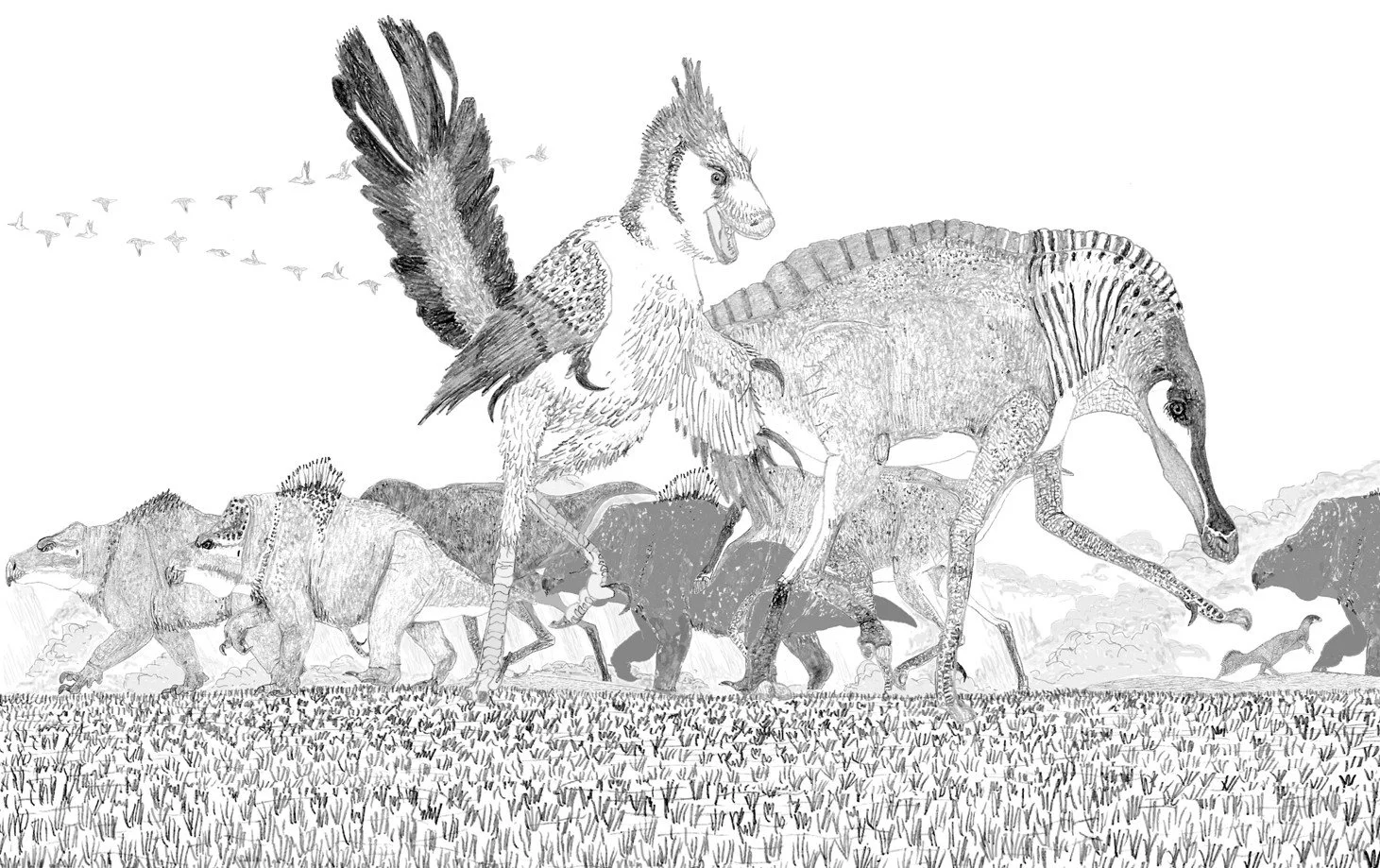
Caption: speculative dinosaurs of a world where the end-Cretaceous event never occurred, itself based on a scene featured in a previous review (Paul 1990) of TND, a scene that might now be criticised as too conservative. A giant, extravagant paravian culls out a dolicocephalic hadrosaurian grazer from a mixed herd that also includes large owlbear leptoceratopsians. A burrowing thescelosaur is visible at right and ducks flock overhead. The locale is the western grasslands of North America. From Naish (2026).
Relevance. Speculative Zoology mostly justifies its existence from its value as entertainment. It’s fun. But in asking questions about things that might have been, or might be at some point, are we doing something more? There’s a greater amount of this sort of thing in the literature than might be obvious: that is, where biologists and palaeontologists have asked questions about things that have seemingly never happened, or, if they have, have only happened once or twice, despite potential. Examples include articles on the distribution of viviparity across reptiles (including birds), body size limits in bats, the rarity of herbivorous aquatic tetrapods, and the supposed absence of suspension-feeding marine reptiles.
In fact, the increased realisation that the animals of the Mesozoic were very much guaranteed a future had a terrible event not occurred – they didn’t just slide into decline due to poor design – has been coupled with views on their diversity and adaptive scope to perhaps make speculations about things that might have been more acceptable. There are the very famous discussions of possible post-Cretaceous intelligence of course (Russell & Séguin 1982, Naish & Tattersdill 2021, Reiner 2023), but there are speculations on other topics too (see Naish 2026).
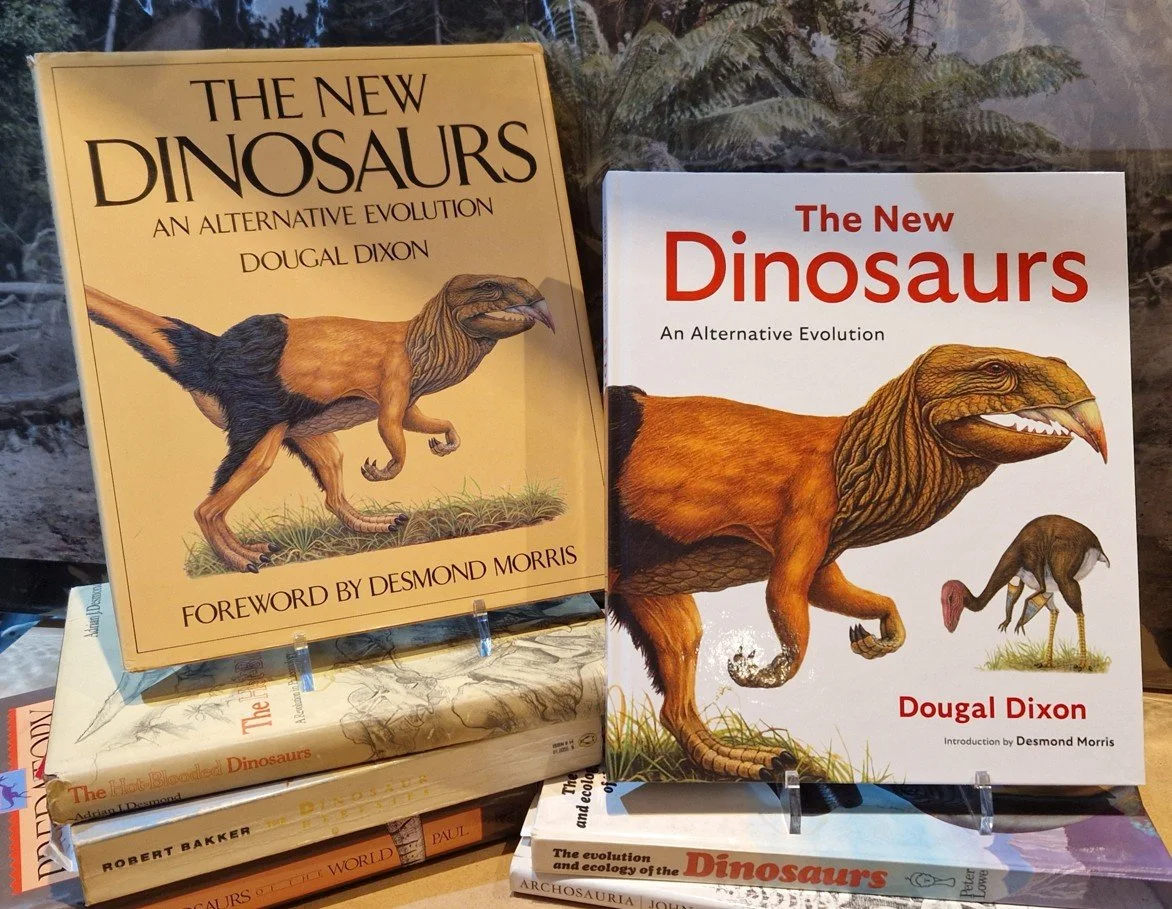
And thus it is that we want The New Dinosaurs. We might even need it. It might even be inevitable that such a book was destined to appear given what I just said about the primacy of ‘what ifs’ in discussions of evolutionary history. Could anyone else have done a better job than Dougal Dixon? Whatever, the fact is that they did not.
Let me know if you want a pdf of my review (not in the comments here: find me on social media or email). These are exciting times if you’re interested in Speculative Zoology, and it’s great news that this classic work – so long hard to get hold of if you missed it first time around – is back in print. Buy it here and tell your friends.
For previous Tet Zoo articles on speculative zoology, see...
The Dougal Dixon After Man Event of September 2018, September 2018
Dougal Dixon’s After Man, the Initial Pitch Document, June 2020
Humanoid Dinosaurs Revisited Again: Russell and Séguin’s Dinosauroid at (Nearly) 40 Years Old, August 2021
Speculative Zoology and the World of After Man; an Interview With Dougal Dixon, April 2025
Speculative Zoology Grand and Photoreal: Boulay and Steyer's Demain, les Animaux du Futur, April 2025
Refs - -
Dixon, D. 2025. The New Dinosaurs: An Alternative Evolution. Breakdown Press, London.
Gee, H. 1988. Tales of future past. Nature 335, 505-506.
Naish, D. 2021. Dinopedia: A Brief Compendium of Dinosaur Lore. Princeton University Press, Princeton NJ.
Naish, D. 2025. Thoughts on reviewing books, from an incoming book review editor. Historical Biology 37, 2591.
Naish, D. 2026. The New Dinosaurs: an alternative evolution. Historical Biology doi 10.1080/08912963.2026.2627439
Naish, D. & Tattersdill, W. 2021. Art, anatomy and the stars: Russell and Séguin’s dinosauroid. Canadian Journal of Earth Sciences 58, 968-979.
Paul, G. S. 1990. An improbable view of Tertiary dinosaurs. Evolutionary Theory 9, 309-315.
Reiner A. 2023. Could theropod dinosaurs have evolved to a human level of intelligence? The Journal of Comparative Neurology 531, 976-1006.
Russell, D. A. & Séguin, R. 1982. Reconstruction of the small Cretaceous theropod Stenonychosaurus inequalis and a hypothetical dinosauroid. Syllogeus 37, 1-43.
Tudge, C. 1988. End points of an alternative evolution. New Scientist 120 (1641), 65-66.
Unwin, D. M. 1992. The New Dinosaurs: An Alternative Evolution (review). Historical Biology 6, 61-71.


